Menu
Sustainability at LP

For more than half a century, we’ve worked to deliver on our purpose: Building a Better World™. Our purpose guides all that we do, from the way we responsibly develop and manufacture products to the way we treat employees and give back to communities.
Our environmental, social and governance (ESG) program demonstrates our purpose at work and the continued evolution of our sustainability journey. Our sustainability program is centered on five pillars: governance, people, environment, products and community.
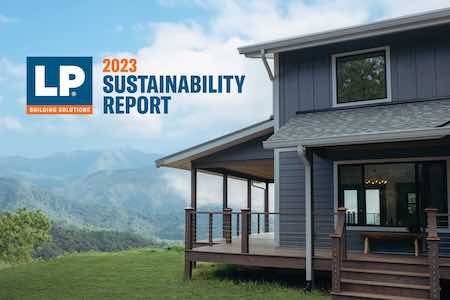
For detailed information about our program, goals and metrics, read our latest Sustainability Report.
"Since our founding, LP has developed innovative building solutions that require less labor to install, increase the energy efficiency of homes and are more environmentally sustainable than competing product alternatives. Our ESG priorities align with our short- and long-term business strategies, enabling us to continue to innovate, lead and deliver on our purpose."
Brad Southern, LP Chair and Chief Executive Officer
LP’s Five Sustainability Pillars



LP TCFD Index
In 2022, we published our first index aligned with the Task Force on Climate-related Financial Disclosures (TCFD) recommendations. The index describes how we evaluate and manage climate-related risks and opportunities and demonstrates the resilience of our business under various climate scenarios. Our Sustainability Report describes our efforts to mitigate potential climate-related risks and take advantage of opportunities.